Portfolio
A writing studio built around books, legacy, business communication and powerful storytelling.
Writing Categories
Books
Ghostwritten manuscripts, non-fiction books, creative works and long-form projects.
Memoirs
Life stories, family histories, personal reflections and legacy books.
Business Writing
Company profiles, proposals, website copy, reports and executive communication.
Speeches
Tributes, corporate speeches, presentations and personal messages.
Military Writing
Veteran stories, operational narratives, unit histories and military fiction.
Editing
Manuscript reviews, rewriting, proofreading, structural editing and polish.

The Dark Clouds Over Ovamboland
The war was over… or so they believed.
On 1 April 1989, as Namibia prepared for peace and independence, thousands of young South African soldiers believed their long war had finally come to an end.
Then, before dawn, the ceasefire was shattered.
Within hours, Ovamboland erupted into one of the final and most intense chapters of the South African Border War—a campaign remembered by many veterans as the Nine Day War.
The Dark Clouds Over Ovamboland is an epic historical military novel that takes the reader into those nine unforgettable days through the eyes of fictional soldiers caught inside real events.
Inside the novel, you will experience:
- The tense days leading up to the ceasefire.
- The shocking morning peace collapsed.
- Fast-moving tracking operations across Ovamboland.
- Koevoet, SWAPOL and SADF units thrown back into combat.
- The confusion of fighting while the world believed there was peace.
- Brotherhood, courage and leadership under immense pressure.
- The beauty of Africa contrasted against the brutality of war.
- A meticulously researched story grounded in the events of April 1989.
This is not a political novel.
It is a tribute to the ordinary men who answered the call, those who
came home carrying memories that never left them, and those who never
returned.
The Dark Clouds Over Ovamboland
In Memory of the Men Who Never Returned.
“History records the events. This novel tells the story of the men who lived them.”
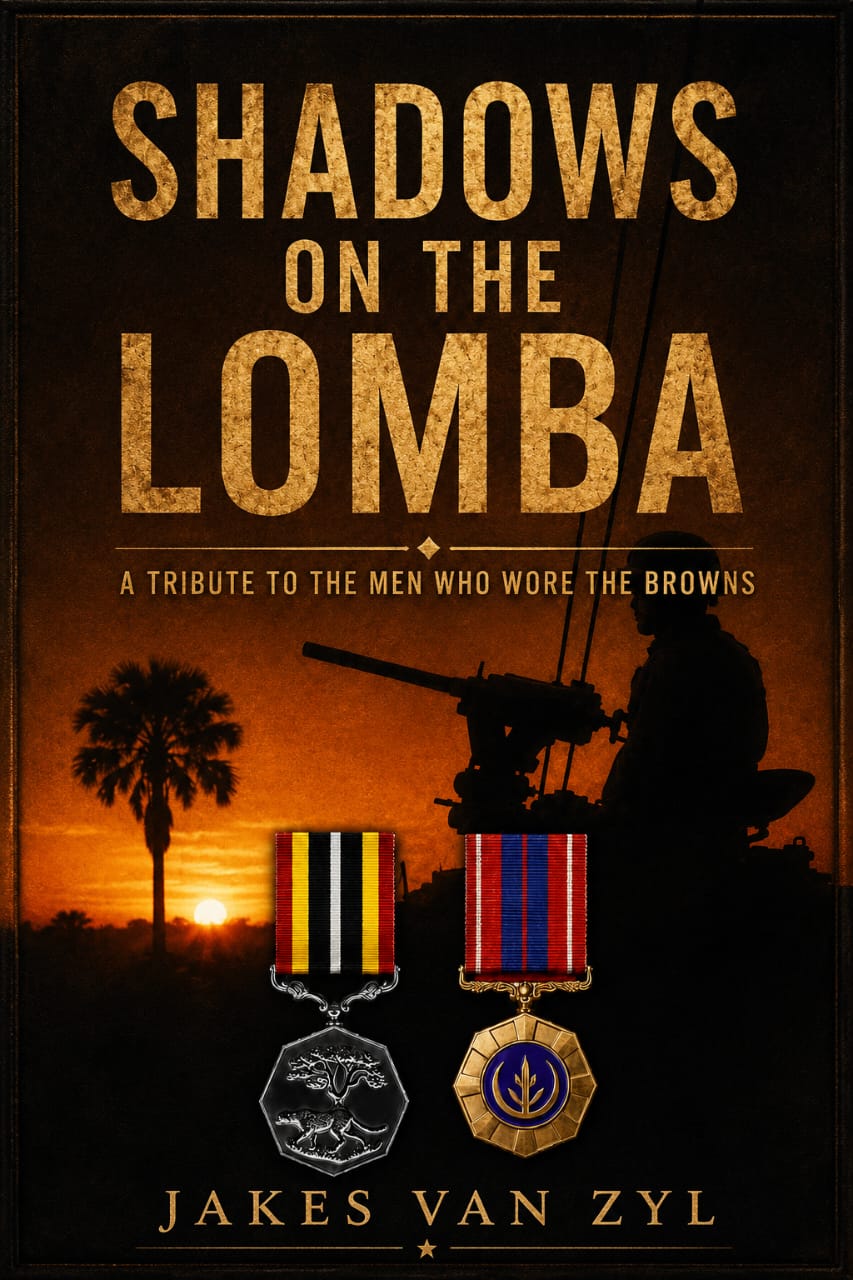
Shadows on the Lomba
History records the battle. This novel tells the story of the men who lived it.
In 1987, deep inside the vast and unforgiving bush of south-eastern Angola, the men of 61 Mechanised Battalion Group moved towards a confrontation that would become one of the defining chapters of the South African Border War.
Shadows on the Lomba is an epic historical military novel inspired by the real events of Operation Moduler and the Battle of the Lomba River.
Through the lives of fictional soldiers placed inside meticulously researched historical events, the novel takes the reader beyond the maps, military reports and political decisions—and into the Ratels, patrol bases, workshops and dusty convoy routes where ordinary men carried the true burden of war.
Inside the story, readers will experience:
- The long and dangerous movement north into Angola.
- The discipline, humour and brotherhood of the men of 61 Mech.
- The mechanical power and vulnerability of the Ratel fighting vehicle.
- Reconnaissance patrols through remote and unforgiving African terrain.
- Minefields, river crossings and the constant strain on men and machines.
- The thunder of G5 artillery and the clash of mechanised forces.
- FAPLA armour, Cuban support and a capable enemy advancing south.
- Leadership decisions where every order carries a human cost.
- The quiet moments between battles that soldiers remember for life.
- The courage, fear, sacrifice and memories carried home by those who survived.
A story grounded in history.
While the principal characters and their personal journeys are
fictional, the campaign, military environment, equipment, terrain and
historical context are carefully researched and faithfully portrayed.
This is not a political account or a glorification of war. It is a
human story about the soldiers who lived inside history.
“Some battles are remembered for their victories. Others are remembered for the men who never returned.”
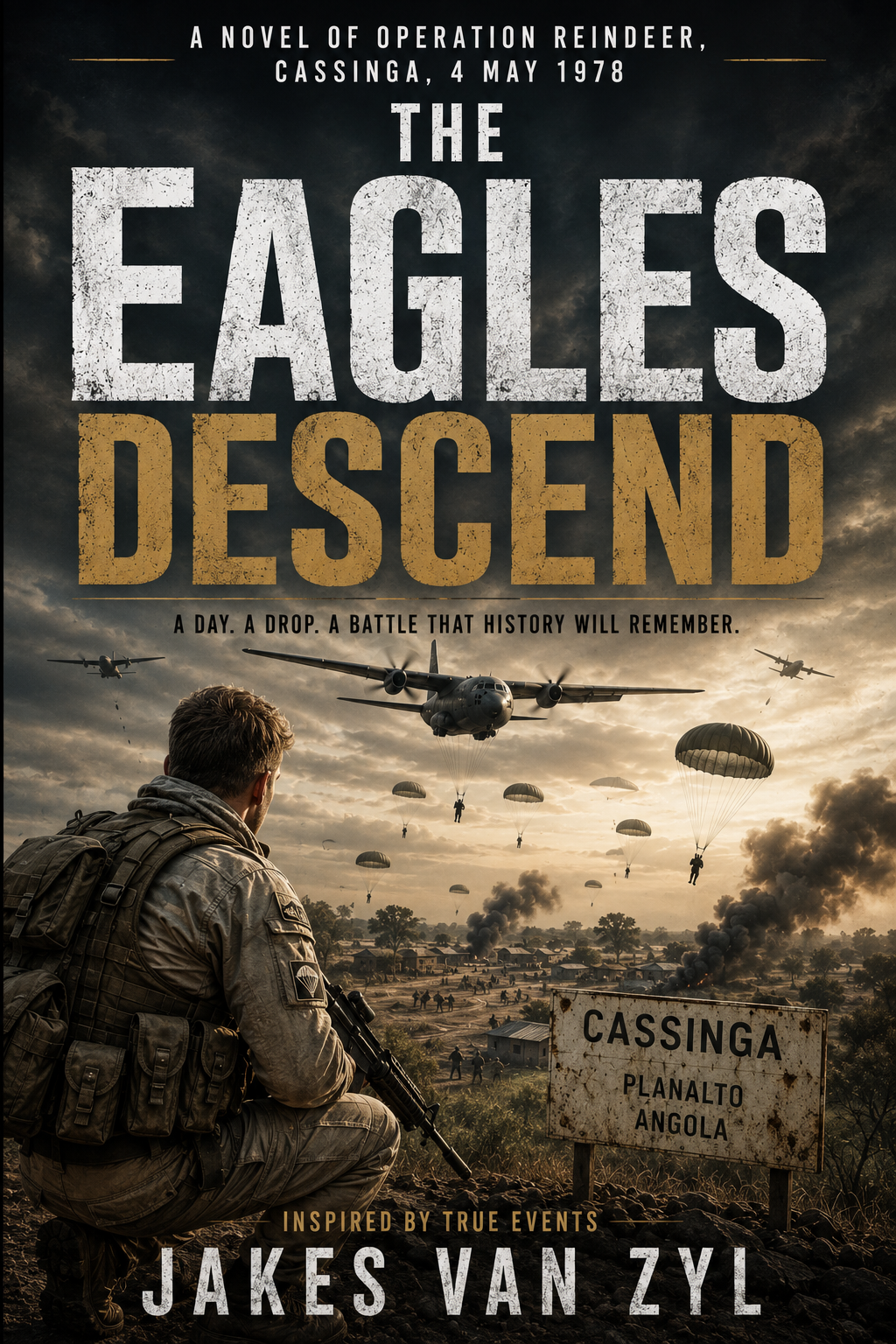
THE EAGLES DESCEND
A Novel of Operation Reindeer, Cassinga, 4 May 1978
Before dawn broke, the silence was shattered.
On 4 May 1978, South African aircraft crossed into Angola carrying hundreds of paratroopers towards Cassinga.
Their mission was bold, dangerous and uncompromising: descend from the sky, strike a heavily defended enemy position and withdraw before reinforcements could close the trap.
But once the first parachutes opened above the battlefield, carefully prepared plans collided with wind, confusion, enemy fire and the brutal uncertainty of war.
The Eagles Descend is a gripping historical military novel inspired by the real events of Operation Reindeer and the Battle of Cassinga. Through fictional characters placed within meticulously researched historical events, the novel follows the paratroopers from the tense hours before take-off to the chaos of the drop zone and the desperate battle for survival on the ground.
This is a story of courage under fire, leadership under impossible pressure and brotherhood forged in the moments when hesitation could cost a man his life.
“Some battles are won. Others are remembered.”
Inspired by true events
Meticulously researched
Authentic military action

THE DIRECTORATE
The Invisible War
“Before the first shot was fired, the invisible war had already begun.”
The South African Border War was fought with rifles, artillery, armoured vehicles and men who crossed into hostile territory knowing they might never return.
But behind every battle was another war.
A war fought through intercepted signals, coded messages, aerial photographs, informants, surveillance and deception.
As Operation Modular gathers momentum in Southern Angola, South African battle groups prepare to confront FAPLA forces supported by Cuban advisers.
Inside the Directorate of Military Intelligence, reports begin to suggest that classified operational information is reaching the enemy. Somewhere within the system, a hidden network is compromising the intelligence on which commanders and soldiers depend.
The investigation is assigned to Major Jakes Cloete.
Cloete must uncover the source of the leak before an entire battle group is sent into an ambush.
Every transmission matters.
Every source carries a risk.
Every trusted man could be the enemy’s greatest weapon.
“Information wins battles. Ego loses them.”
The Directorate: The Invisible War is a historically grounded military espionage thriller inspired by the intelligence environment surrounding Operations Modular, Hooper and Packer.
The principal characters and covert storyline are fictional, while the military operations, geography, equipment and historical setting are portrayed with respect for the period.
The soldiers fought the battles history remembers.
The Directorate fought the war history never saw.
Executive Thought Leadership
Why Every CEO Should Write a Book Before They Retire
Your greatest business asset is not your company. It is the knowledge you have accumulated over a lifetime—and a book is one of the most powerful ways to preserve and multiply its value.
Some of the Most Valuable Businesses in the World Leave Nothing Behind
Every year, thousands of business owners retire, sell their companies, or quietly step away from leadership.
What often disappears with them is not the business itself. It is the decades of hard-earned experience that made the business successful in the first place.
Lessons learned through failure.
Leadership decisions made under pressure.
Negotiations that changed the course of a company.
Strategies that never appeared in a textbook.
Relationships built over decades.
The wisdom to recognize opportunities before competitors did.
When leaders leave without documenting what they have learned, much of that knowledge is lost forever.
A book preserves experience, extends influence, and transforms years of practical expertise into a lasting business asset.
Expertise Alone Does Not Build Authority
Many executives assume that because they are successful, others automatically recognize their expertise.
Unfortunately, the marketplace does not work that way.
Today’s clients, investors, partners, and employees make judgments long before they ever meet you.
They search online.
They read your articles.
They visit your website.
They review your LinkedIn profile.
They look for evidence that you are a recognized authority.
Without published work, much of your expertise remains invisible.
A professionally written book changes the conversation.
Instead of saying you are experienced, you demonstrate it. Instead of claiming authority, you establish it.
A published book signals commitment, depth of knowledge, and credibility in a way few other marketing tools can.
A Book Works Long After You Stop Working
Marketing campaigns end.
Advertisements disappear.
Social media posts have a lifespan measured in hours.
Even the best website requires continual maintenance.
A well-written book can continue working for you for years.
It introduces you before meetings.
It strengthens sales conversations.
It opens doors to speaking engagements.
It supports media interviews.
It becomes a premium gift for clients.
It builds trust before the first conversation takes place.
Unlike advertising, a book can appreciate in value as more people discover, reference, recommend, and share it.
It becomes intellectual property—an asset that can serve both you and your business indefinitely.
People Do Not Buy Services. They Buy Confidence.
Business decisions are rarely based on price alone. Prospective clients are constantly evaluating risk.
A book answers those questions before they are asked.
It allows prospective clients to experience your thinking. It demonstrates how you approach problems, showcases your methodology, and reveals the principles behind your decisions.
Most importantly, it builds confidence.
Confidence reduces perceived risk. Reduced risk creates better opportunities.
The CEOs Who Need a Book Most Often Believe They Have No Time
One of the most common objections executives make is simple:
“I would love to write a book, but I simply do not have the time.”
Ironically, these are often the people with the most valuable stories and lessons to share.
Running a business demands focus. Leading teams requires constant decision-making. Balancing clients, operations, travel, strategy, and family leaves little room for writing hundreds of pages.
The result is predictable. Years pass. Ideas remain unfinished. Eventually, the opportunity disappears.
The issue is usually not a lack of ideas.
It is a lack of capacity.
Writing a Book Is a Business Project
Many people think writing begins with a blank page. Professional writers know it begins with research and structure.
A successful business book is rarely created by inspiration alone.
It requires structure.
Planning.
Interviews.
Fact-checking.
Audience analysis.
Message development.
Editorial discipline.
Professional book development resembles building a business strategy more than keeping a diary.
The writing itself is only one part of the process.
Why Successful Leaders Work With Ghostwriters
There remains a misconception that using a ghostwriter somehow diminishes the authenticity of a book.
In reality, a professional ghostwriter does not invent your expertise.
A strong ghostwriter reveals it.
The ghostwriter’s role is to ask better questions, organize years of experience into a logical framework, identify recurring themes, transform technical language into engaging prose, and maintain consistency throughout the manuscript.
The knowledge remains yours.
The ideas remain yours.
The stories remain yours.
The decisions remain yours.
The voice remains yours.
The ghostwriter ensures those ideas become a book worth reading.
Your Story Is More Valuable Than You Think
Many executives underestimate how unusual their careers actually are.
What feels ordinary to you may be extraordinary to someone beginning the same journey.
You may have built companies during economic downturns.
You may have led teams through crisis.
You may have expanded into international markets.
You may have negotiated acquisitions.
You may have recovered from failure.
You may have developed innovative systems.
You may have managed difficult stakeholders.
You may have solved problems others considered impossible.
Experience creates perspective. Perspective creates wisdom. Wisdom deserves preservation.
A Book Creates Opportunities You Cannot Predict
Few successful authors can identify the single opportunity that justified writing their book.
Instead, opportunities accumulate.
An invitation to speak.
A media interview.
A consulting engagement.
A strategic partnership.
A board appointment.
A university lecture.
A keynote conference.
An acquisition discussion.
A referral from someone who read a single chapter.
Books rarely produce one dramatic outcome. They produce hundreds of smaller opportunities that compound over time.
Legacy Is More Than Wealth
Financial success can be measured.
Legacy cannot.
One generation builds businesses. The next often inherits only fragments of the story.
A book provides context. It explains why decisions were made, what values mattered, what principles guided difficult choices, and what lessons future leaders should remember.
It becomes a record of both achievement and character.
Years after contracts have expired and companies have changed ownership, your ideas can continue shaping future entrepreneurs, professionals, and leaders.
The Process Does Not Need to Be Overwhelming
Many executives imagine writing a book as an isolated, year-long exercise.
Professional book development is far more structured.
Discovery
Clarifying your objectives, audience, core message, positioning, and desired commercial outcome.
Research
Reviewing existing material, presentations, reports, notes, articles, recordings, and source documents.
Planning
Building a detailed book structure and chapter framework before full drafting begins.
Interviews
Capturing stories, examples, insights, turning points, and lessons through guided conversations.
Writing
Transforming your knowledge into compelling chapters while protecting your authentic voice.
Review
Refining structure, accuracy, tone, consistency, readability, and narrative strength.
Publication
Preparing the completed manuscript for traditional publishing or professional independent release.
At no point does the executive need to become a full-time writer.
The executive simply contributes the knowledge only they possess.
The Cost of Waiting
Many executives intend to write “someday.”
Someday after retirement.
Someday after the next acquisition.
Someday after the current crisis.
Someday after business slows down.
Yet business rarely becomes less demanding.
Memories fade. Documents disappear. Colleagues move on. Important stories become harder to reconstruct.
The best time to document experience is while it remains vivid.
Waiting often costs far more than beginning.
Your Book Is Not About You
This may sound surprising, but the best business books are rarely simple autobiographies.
They are guides.
Frameworks.
Lessons.
Solutions.
Readers do not buy books merely because they want to admire successful people. They buy books because they want to solve problems.
When your experience becomes useful to others, your book becomes valuable.
Great Books Build Great Reputations
Every respected industry contains individuals whose names have become synonymous with expertise.
Often, those reputations were strengthened not only by success, but by publishing.
Books remain one of the few mediums capable of communicating complex ideas with depth.
They demonstrate commitment.
Discipline.
Credibility.
Thoughtfulness.
They position the author as someone worth listening to.
That reputation often extends far beyond the pages themselves.
Final Thoughts
Every executive eventually reaches a point where experience outweighs ambition.
When that happens, knowledge becomes one of your greatest assets.
The question is not whether your experience has value.
It does.
The question is whether future generations, clients, colleagues, and aspiring leaders will ever have the opportunity to benefit from it.
A business can be sold. A position can be replaced. A title can be forgotten.
But well-documented ideas can continue influencing people long after their author has stepped away.
The leaders remembered most are rarely those who merely accumulated success.
They are the ones who shared what they learned.
Perhaps your greatest contribution to your industry is not only the company you built. Perhaps it is the book you have not written yet.
Turn Experience Into Authority
Your expertise deserves more than an unfinished manuscript.
The Word Peddler helps executives, entrepreneurs, professionals, and subject-matter experts transform their knowledge into credible, professionally written books and thought leadership content.
Discuss Your BookBusiness Communication & Brand Authority
The Hidden Cost of Poor Business Writing
Weak writing does more than create an untidy document. It quietly reduces sales, weakens investor confidence, damages reputation, disrupts employees, and gives customers reasons not to trust you.
Most businesses measure the visible costs of poor performance. They track wasted advertising spend, lost stock, missed deadlines, faulty products, and failed sales campaigns.
Yet one of the most expensive weaknesses in business is rarely measured at all: poor writing.
It appears in proposals that fail to persuade, websites that confuse, reports that bury the important point, emails that create friction, and sales material that sounds exactly like everyone else.
Because these losses are distributed across departments and relationships, they seldom appear as a single line item on a financial statement. The business sees lower conversion rates, slow decisions, internal mistakes, weak engagement, and declining trust. It does not always recognise writing as the cause.
Poor business writing is not merely a communication problem. It is a commercial liability.
Every document sent by a business represents its competence. Every email influences a relationship. Every proposal either reduces uncertainty or adds to it. Every sentence either builds confidence or weakens it.
Good writing makes a business easier to understand, easier to trust, and easier to buy from. Poor writing does the opposite.
Poor Writing Makes Selling Harder
A customer cannot buy what they do not understand.
This sounds obvious, yet many companies force prospective customers to work far too hard to determine what is being offered, why it matters, and what they should do next.
The problem is rarely a total absence of information. More often, it is too much information presented without priority, structure, or persuasive force.
When the message is unclear, the buyer hesitates. When the buyer hesitates, the sales cycle becomes longer. When the sales cycle becomes longer, the cost of acquisition increases.
Poor writing also creates unnecessary objections. A vague proposal makes the price appear higher because the value is not sufficiently explained. Generic claims make competitors appear interchangeable. Long, dense copy makes decision-makers postpone reading it.
The sale is often lost before a salesperson has the opportunity to answer the customer’s questions.
Strong business writing does not manipulate a buyer. It makes the decision easier by clarifying the problem, the solution, the value, the evidence, and the next step.
Investors Read Uncertainty as Risk
Investors are not only evaluating an idea. They are evaluating the people responsible for executing it.
A confused business plan, inconsistent investor deck, weak executive summary, or badly structured proposal raises a question that may never be spoken aloud:
“If the leadership team cannot explain the business clearly, can it manage the business effectively?”
Investors look for disciplined thinking. Clear writing is one of the strongest visible signs of that discipline.
A strong investment document should establish the opportunity, define the market, explain the model, present evidence, acknowledge risk, show how capital will be used, and make the return logic easy to follow.
Poor writing damages confidence when it:
Hides the Core Proposition
Investors must search through pages of background information to understand what the business actually does.
Uses Unsupported Claims
Words such as “leading,” “unique,” and “revolutionary” are used without evidence, market context, or defensible proof.
Creates Numerical Confusion
Financial assumptions, timelines, costs, and returns contradict one another or are not explained clearly.
Reveals Weak Preparation
Errors, inconsistent terminology, and poor structure suggest a lack of attention to detail.
A well-written investor document cannot rescue a weak business model. But poor writing can certainly destroy confidence in a strong one.
Investors do not fund what they cannot understand, verify, or trust.
Your Reputation Is Written Before It Is Spoken
A business may invest heavily in logos, offices, vehicles, uniforms, websites, presentations, and advertising. Yet its reputation can still be weakened by one careless document.
Customers and partners often encounter the company’s writing before they meet its people. That writing becomes a proxy for competence.
A poorly written website suggests a business that tolerates weak standards. A confusing proposal suggests an organisation that may be difficult to work with. An error-filled report suggests unreliable quality control.
These conclusions may not always be fair, but they are commercially real.
Poor Writing Signals
- Lack of attention to detail
- Unclear thinking
- Weak professionalism
- Inconsistent standards
- Higher perceived risk
Strong Writing Signals
- Commercial competence
- Strategic clarity
- Professional discipline
- Reliable standards
- Confidence and credibility
Reputation is not created only through major public relations campaigns. It is built through thousands of smaller moments: quotations, emails, reports, profiles, presentations, instructions, contracts, articles, and responses to complaints.
Each of these moments either reinforces the brand promise or contradicts it.
Bad Internal Writing Creates Expensive Confusion
Poor writing does not only affect customers. It also slows the people inside the business.
Employees rely on written communication to understand priorities, responsibilities, procedures, deadlines, standards, and decisions. When those instructions are vague, inconsistent, or unnecessarily complex, work becomes slower and mistakes become more likely.
The cost appears as rework, delay, frustration, duplication, and avoidable conflict.
Poor internal communication can also damage accountability. When roles, standards, and expected outcomes are not clearly documented, managers struggle to determine whether an employee failed to perform or was never properly instructed.
Clarity is not a cosmetic improvement. It is an operational control.
Good internal writing gives employees a common understanding of what must happen, who owns the task, when it is due, and what successful completion looks like.
Customer Trust Is Lost in Small Moments
Trust is often discussed as if it is built through dramatic gestures. In reality, customers usually decide whether a company is trustworthy through repeated, ordinary interactions.
Was the quotation clear?
Did the website answer the obvious questions?
Did the confirmation email explain what would happen next?
Did the business respond to a complaint with honesty and precision?
Did the terms and conditions make sense?
Unclear writing creates suspicion because customers begin wondering what else may be unclear.
Ambiguous pricing creates fear of hidden costs. Vague promises create fear of disappointment. Contradictory information creates fear that the business is disorganised.
Customers trust businesses that make them feel informed, respected, and certain about what happens next.
Strong writing reduces anxiety. It shows the customer that the business has anticipated their concerns and is prepared to communicate openly.
The Real Cost Is Cumulative
One badly written email may not destroy a business. One confusing paragraph may not end a customer relationship. One weak proposal may not damage a brand permanently.
The danger lies in accumulation.
A lower conversion rate here. A delayed decision there. A customer who quietly chooses a competitor. An employee who misunderstands an instruction. An investor who does not request a second meeting.
None of these losses may be attributed directly to writing. Together, however, they form a substantial commercial drag.
Lost Revenue
Prospects fail to see the value, delay decisions, or choose a competitor whose message is easier to understand.
Wasted Time
Employees explain, rewrite, correct, clarify, and repeat information that should have been clear from the beginning.
Weaker Relationships
Customers, partners, and investors become less confident in the business and more cautious in their decisions.
Reduced Authority
The company appears less capable, less distinctive, and less credible than it actually is.
Businesses often attempt to solve these problems by buying more advertising, changing sales staff, redesigning the website, or increasing outreach.
Sometimes the real problem is simpler: the business has not explained itself properly.
Clear Writing Begins With Clear Thinking
Strong business writing is not created by replacing simple words with impressive ones.
It begins by understanding the objective.
What must the reader know? What must they believe? What decision must they make? What uncertainty must be removed? What action must follow?
Without these answers, even grammatically correct writing can remain commercially weak.
Effective business writing usually requires five disciplines:
Define the Reader
Write for the knowledge, concerns, priorities, and expectations of the specific audience—not for an imaginary general public.
Clarify the Objective
Decide exactly what the document must achieve before choosing what information to include.
Structure the Argument
Present information in the order the reader needs it, not the order in which the writer happened to think of it.
Remove Friction
Eliminate jargon, repetition, vague claims, unnecessary length, conflicting messages, and buried conclusions.
Strengthen the Decision
Support important claims with evidence and make the required next step obvious.
Good writing respects the reader’s time. It delivers the right information with enough context to create understanding, but without forcing the reader to excavate the meaning.
When Professional Writing Becomes a Business Investment
Not every email requires a professional writer. Not every internal memo needs an editorial process.
But high-stakes documents deserve high standards.
A business should consider professional writing support when the document influences revenue, investment, reputation, strategic partnerships, regulation, public understanding, or major internal change.
Professional writing is not simply the correction of grammar. It is the disciplined translation of business value into language that the reader can understand, trust, and act upon.
Final Thoughts
Businesses are judged by what they deliver. They are also judged by how clearly they explain what they deliver.
Poor writing increases uncertainty. It makes sales harder, investment less likely, employees less effective, customers less confident, and reputations more fragile.
Strong writing does not guarantee commercial success. But it removes obstacles that should never have existed.
It helps customers understand value. It helps investors assess the opportunity. It helps employees execute. It helps leaders establish authority. It helps the business sound as capable as it truly is.
Your business may already be paying for poor writing. The only question is whether you can see the cost.
Clarity Creates Commercial Confidence
Make your business sound as professional as the work it delivers.
The Word Peddler develops persuasive, research-driven business writing for companies, executives, entrepreneurs, consultants, and subject-matter experts. From strategic website copy and company profiles to proposals, reports, thought leadership, and executive books, every project is built to communicate value with clarity and authority.
Discuss Your Writing ProjectConfidential projects and ongoing freelance writing support are available.
Artificial Intelligence, Writing & Human Judgment
Why AI Will Never Replace Great Writers (But Will Replace Average Ones)
Artificial intelligence is not destroying professional writing. It is exposing the difference between producing words and creating work that earns attention, trust, and action.
Artificial intelligence can produce a thousand words before most writers have finished their first paragraph.
It can generate headlines, rewrite emails, summarise documents, draft blog posts, organise research, suggest structures, and imitate almost any professional tone.
This has led to one of the most repeated questions in the modern creative economy:
Will artificial intelligence replace writers?
The honest answer is uncomfortable.
AI will replace many writers.
It will replace writers whose work is generic, predictable, unresearched, mechanically structured, and indistinguishable from everything else already published online.
It will replace writers who believe their value lies in producing sentences rather than solving communication problems.
It will replace writers who charge clients for information that can be generated in seconds without specialist judgment.
But it will not replace great writers.
AI can generate language. Great writers generate meaning, judgment, trust, and consequence.
The real divide is no longer between human writing and machine writing. It is between ordinary output and valuable thinking.
AI Has Already Changed the Definition of Average
Before generative AI became widely available, many businesses accepted mediocre writing because producing something better required more time, money, and effort.
Average content survived because it was cheaper than excellent content and better than having no content at all.
That advantage has disappeared.
AI can now produce acceptable first drafts of ordinary business material almost instantly. It can create competent service descriptions, straightforward blog posts, simple social media copy, product summaries, and internal communications.
This means that “acceptable” is no longer a valuable professional standard.
Writers who built their careers on producing competent but forgettable content are now competing against technology that can deliver similar output faster and at negligible marginal cost.
AI did not lower the standard for professional writers. It raised the minimum standard required to remain valuable.
The Problem Was Never the Blank Page
Much of the public conversation about writing focuses on production.
How quickly can the words be generated? How many articles can be published? How efficiently can content be scaled?
These questions treat writing as if it were a manufacturing process in which the number of words produced is the primary measure of value.
That may be true for low-risk, high-volume content. It is not true for writing that influences reputation, investment, leadership, sales, public opinion, or legacy.
The hardest part of professional writing is rarely typing.
The hardest part is deciding:
These are not typing decisions.
They are editorial, strategic, psychological, and commercial decisions.
AI Predicts Language. Great Writers Exercise Judgment.
Artificial intelligence is exceptionally powerful because it can recognise patterns in enormous quantities of language.
It can suggest the next plausible sentence, the next likely argument, or the next familiar structure.
But plausibility is not the same as judgment.
A great writer knows when the obvious answer is too shallow. They know when a client’s preferred message is legally risky, strategically weak, emotionally dishonest, or unsupported by evidence.
They know when a document should be shorter, when a claim should be removed, when an interview answer contains the real story, and when a polished sentence conceals unclear thinking.
Context
Great writers understand the client’s history, market, reputation, sensitivities, objectives, and audience—not only the words in the prompt.
Consequences
They consider what a statement may trigger, imply, expose, damage, strengthen, or permanently place on record.
Discernment
They distinguish between what sounds impressive and what is actually true, relevant, persuasive, and useful.
Responsibility
They take ownership of the final message and understand that words can influence money, careers, decisions, and reputations.
The more important the consequences of the writing, the more valuable human judgment becomes.
Great Writing Contains Something the Machine Cannot Supply: Lived Perspective
A machine can describe a boardroom.
A great writer can understand the silence after a failed acquisition, the tension between a founder and an investor, or the private weight of making a decision that affects hundreds of employees.
AI can summarise leadership theory.
A great writer can recognise the lesson hidden inside a leader’s hesitation, contradiction, regret, or change of mind.
This distinction matters because memorable writing is not built only from information. It is built from observation.
Great writers notice what others overlook.
They hear the sentence behind the sentence.
They identify the experience that contains the deeper principle.
They understand that facts may explain what happened, while human detail explains why the reader should care.
Information can be generated. Perspective must be developed.
AI Can Imitate Voice. Great Writers Protect Identity.
One of AI’s most impressive abilities is stylistic imitation.
It can produce formal language, conversational language, persuasive language, technical language, and executive language.
But a recognisable voice is more than tone.
It is the relationship between vocabulary, rhythm, worldview, experience, humour, restraint, cultural background, professional identity, and personal conviction.
A skilled ghostwriter does not simply make a client sound polished.
They make the client sound unmistakably like themselves—only clearer, stronger, and more disciplined.
This requires close listening.
It requires noticing the phrases a client repeats, the ideas they resist, the stories they tell differently each time, the values they defend, and the subjects that change their energy.
AI can reproduce patterns from supplied material. A great writer can recognise which patterns are essential to identity and which are merely habits that weaken the message.
Average Writers Deliver Text. Great Writers Solve Problems.
The average writer asks, “How many words do you need?”
The great writer asks, “What must this writing achieve?”
That difference changes everything.
Average Writing
- Follows the brief without challenging weak assumptions
- Measures value by length and delivery speed
- Uses familiar phrases and predictable structures
- Repeats available information
- Produces content that sounds professional but generic
- Requires the client to do the strategic thinking
Great Writing
- Clarifies the real objective behind the brief
- Identifies gaps, risks, contradictions, and opportunities
- Builds a deliberate argument for a specific audience
- Transforms expertise into useful insight
- Creates distinctive authority and trust
- Improves the client’s thinking as well as the final text
Businesses do not ultimately need more words.
They need clearer positioning, stronger arguments, credible authority, better decisions, and communication that moves people.
The writer who can deliver those outcomes will remain valuable.
The Real Threat Is Not AI. It Is Sameness.
The internet was already crowded before generative AI arrived.
Now it is becoming saturated with content that is grammatically clean, structurally competent, and emotionally empty.
Much of it uses the same patterns:
The result is not necessarily bad writing.
It is invisible writing.
It blends into the surrounding noise because it offers no distinctive experience, argument, risk, conviction, or point of view.
In a world of unlimited content, originality becomes more valuable—not less.
Great writers do not merely arrange familiar ideas attractively.
They notice what others have missed. They make connections others have not made. They frame familiar problems in ways that create fresh understanding.
AI Will Expose Writers Who Have No Point of View
A writer without a point of view is vulnerable because their work can be reproduced by any system trained on existing language.
This does not mean every article must be controversial.
It means the writer must bring intellectual direction.
A point of view answers questions such as:
Great writing has direction because the writer has made decisions.
It does not hide behind balanced language when a conclusion is required.
It does not manufacture certainty, but it does not avoid responsibility either.
The Best Writers Will Use AI
Defending great writing does not require rejecting artificial intelligence.
That would be foolish.
AI is a powerful professional tool when used with discipline.
It can accelerate research preparation, suggest alternative structures, identify repetition, test headlines, summarise interviews, compare drafts, generate questions, and support editorial review.
The strongest writers will use AI to reduce low-value labour so they can spend more time on high-value thinking.
But they will not surrender judgment to it.
Use AI for Exploration
Generate possibilities, questions, structural alternatives, and research directions without treating the first output as the final answer.
Verify Every Important Claim
Check facts, dates, quotations, technical details, legal implications, and source quality before publication.
Apply Human Editorial Judgment
Decide what belongs, what must be removed, what requires nuance, and what the reader genuinely needs.
Restore Voice and Specificity
Replace generic phrasing with lived detail, clear examples, original insight, and language suited to the real author.
Take Responsibility for the Result
Never publish an output merely because it sounds convincing. Professional writers remain accountable for accuracy, integrity, clarity, and consequence.
AI should strengthen the writer’s process. It should never replace the writer’s responsibility.
Clients Will Pay Less for Words and More for Judgment
The economics of professional writing are changing.
Businesses will become less willing to pay premium fees for basic drafting that can be automated.
At the same time, they will pay more for writers who can:
Extract Expertise
Interview founders, executives, specialists, and professionals in a way that uncovers useful knowledge they struggle to express.
Build Authority
Transform experience into books, reports, articles, and strategic content that strengthen professional credibility.
Manage Complexity
Organise technical, commercial, historical, or specialist information into clear and defensible communication.
Protect Reputation
Recognise weak claims, misleading language, factual gaps, tonal risks, and messaging that could damage trust.
The future professional writer is not simply a content producer.
They are an interviewer, researcher, strategist, editor, interpreter, fact-checker, and custodian of voice.
What Great Writers Must Do to Remain Irreplaceable
Talent alone will not protect a writer from technological change.
Writers must deliberately move toward work that requires deeper human capability.
Develop Specialist Knowledge
Writers who understand industries, professions, markets, and technical subjects can offer more than surface-level language.
Become Better Interviewers
Valuable ideas often exist in the client’s mind before they exist in documents. Strong interviewing turns hidden knowledge into usable material.
Learn Commercial Strategy
Understand how writing supports sales, investment, authority, reputation, leadership, and customer trust.
Strengthen Research Discipline
Verify claims, evaluate sources, distinguish fact from assumption, and understand when evidence is weak or incomplete.
Build a Distinctive Point of View
Do not merely repeat what is already known. Develop informed opinions that are useful, defensible, and recognisably your own.
Become Ruthless Editors
The ability to remove weak material, tighten arguments, and improve clarity will become more valuable as automated output expands.
The Human Reader Still Matters
Every business document, book, article, proposal, speech, or website is ultimately created for a human being.
That reader may be distracted, sceptical, impatient, ambitious, frightened, curious, proud, exhausted, or uncertain.
Great writing respects that reality.
It does not treat the reader as a data point.
It anticipates resistance, answers doubt, creates recognition, and rewards attention.
It knows when to explain and when to stop.
It knows that persuasion without trust is manipulation, and information without relevance is noise.
The future of writing will still depend on understanding people, because people remain the ones who decide, trust, buy, follow, and remember.
Final Thoughts
Artificial intelligence will not end professional writing.
It will end the comfortable market for writers whose only advantage was the ability to produce competent sentences.
Average work will become cheaper, faster, and more plentiful.
Great work will become easier to recognise because it will contain what automated output so often lacks: judgment, lived perspective, originality, responsibility, and a clear understanding of human consequence.
The writers who survive will not be those who compete with AI at producing more words.
They will be those who use every available tool while remaining responsible for meaning.
AI will replace writers who merely produce content. It will strengthen writers who know how to think.
Human Judgment. Professional Writing.
Your expertise deserves more than generic content.
The Word Peddler helps executives, entrepreneurs, professionals, and subject-matter experts transform their knowledge into credible books, thought leadership, reports, articles, and strategic business content. AI may support the process, but every project is guided by human research, editorial judgment, voice, and accountability.
Discuss Your Writing ProjectConfidential ghostwriting, business writing, and ongoing freelance support are available.